What Is a Deterministic Reasoning Layer for AI Agents?
Synalinks Team
What Is a Deterministic Reasoning Layer for AI Agents?
Ask an AI agent the same question twice, with the same data, and you might get two different answers. Change the phrasing slightly and you might get a third. This isn't a bug in your prompt. It's a fundamental property of how most AI agents work.
Language models are probabilistic. They predict the next most likely token given a context window. That's powerful for generating natural language, but it's a problem when you need consistent, verifiable answers from your AI systems.
A deterministic reasoning layer solves this by separating reasoning from generation. Instead of asking a language model to figure out the answer, you give it an answer that was already derived through rule-based logic over structured knowledge.
Same question. Same data. Same answer. Every time.
How probabilistic AI agents work today
The standard architecture for production AI agents looks like this:
- A user asks a question
- The system retrieves relevant documents using vector similarity search (RAG)
- The retrieved context and the question are sent to a language model
- The language model generates a response
This works reasonably well for open-ended questions, summarization, and creative tasks. But it has three structural problems for business-critical applications:
Non-determinism. The same inputs can produce different outputs across calls. Temperature settings help, but even at temperature zero, model updates, context ordering, and tokenization differences introduce variation.
No reasoning chain. The model doesn't show its work. You get a final answer, but you can't trace how it arrived there. If the answer is wrong, you can't pinpoint where the reasoning failed.
Conflation of retrieval and reasoning. The model has to do two jobs at once: figure out which retrieved information is relevant, and reason over it to produce an answer. When these jobs are entangled, errors compound silently.
What a deterministic reasoning layer does differently
A deterministic reasoning layer sits between your data and your AI agent. It handles the reasoning, so the language model doesn't have to.
Here's the architecture:
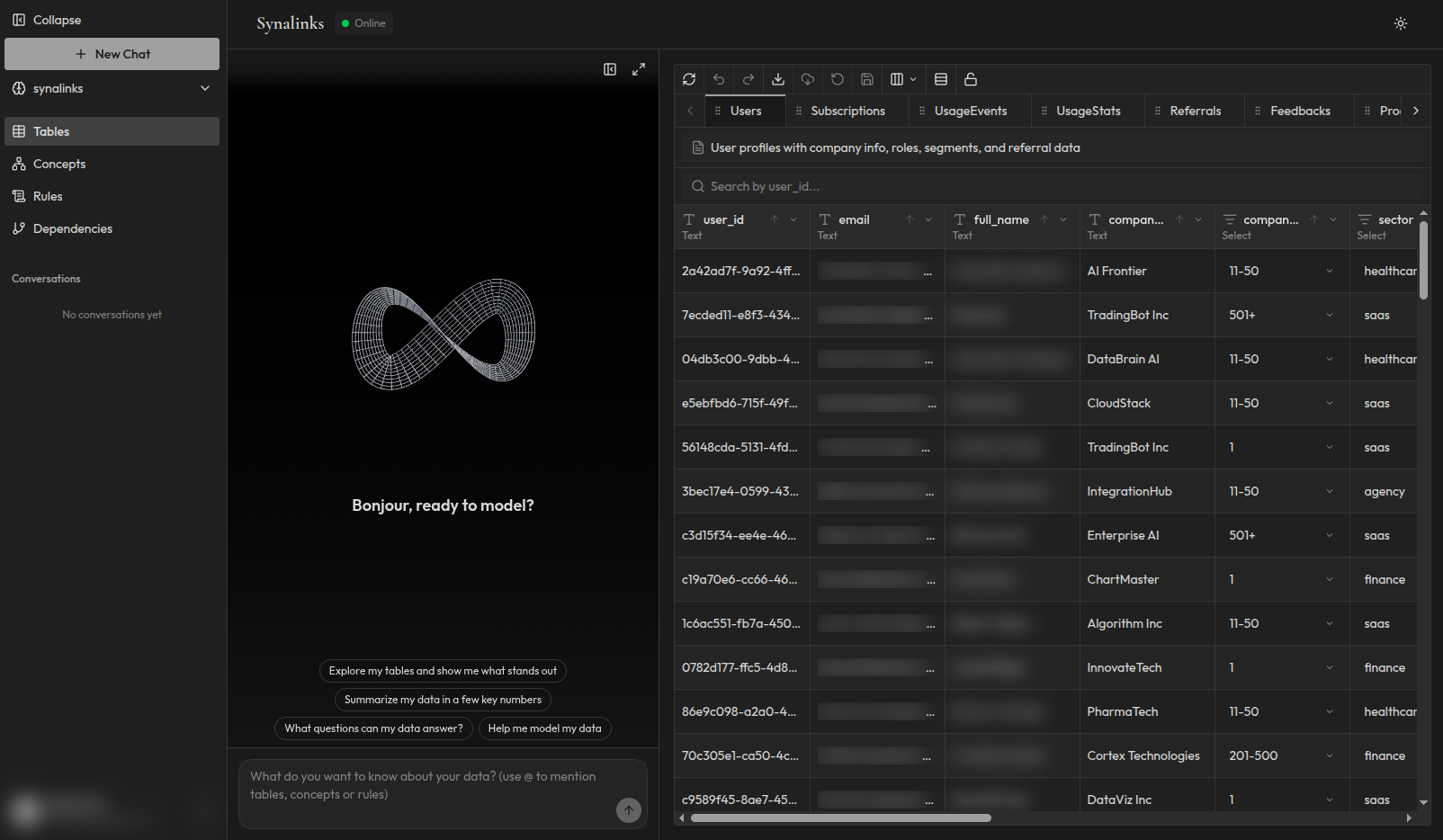
Step 1: Structure the knowledge. Instead of storing documents as vector embeddings, your data is organized into verified concepts, relationships, and rules. A customer isn't just a chunk of text, it's an entity with typed properties and defined relationships to orders, subscriptions, support tickets, and more.
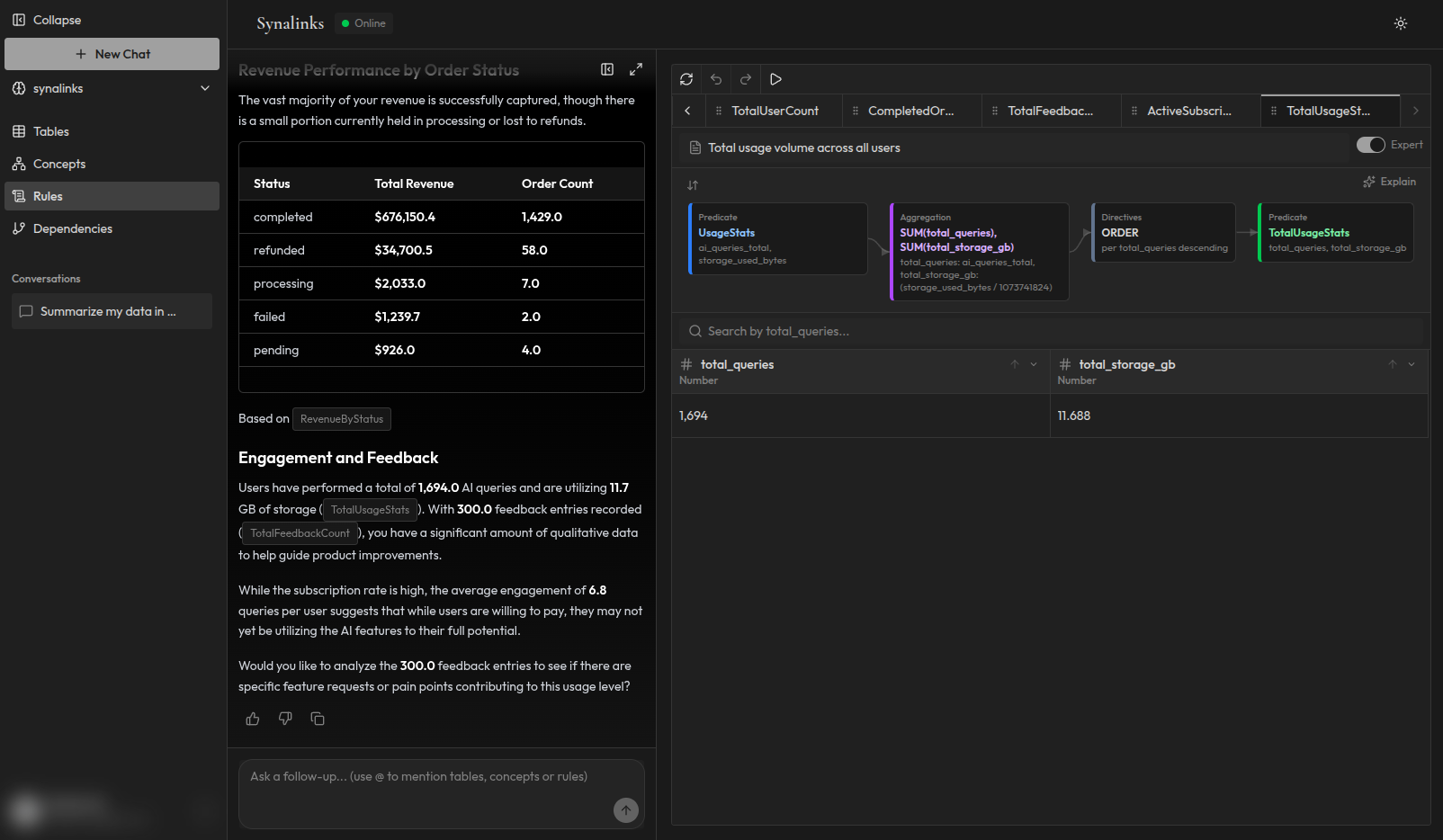
Step 2: Define the logic. Business rules, domain constraints, and reasoning patterns are encoded explicitly. "Overdue" means more than 30 days past the due date. "At risk" means a customer whose usage dropped by 40% over the last quarter and has unresolved support tickets. These rules aren't buried in prompts. They're first-class objects in the system.
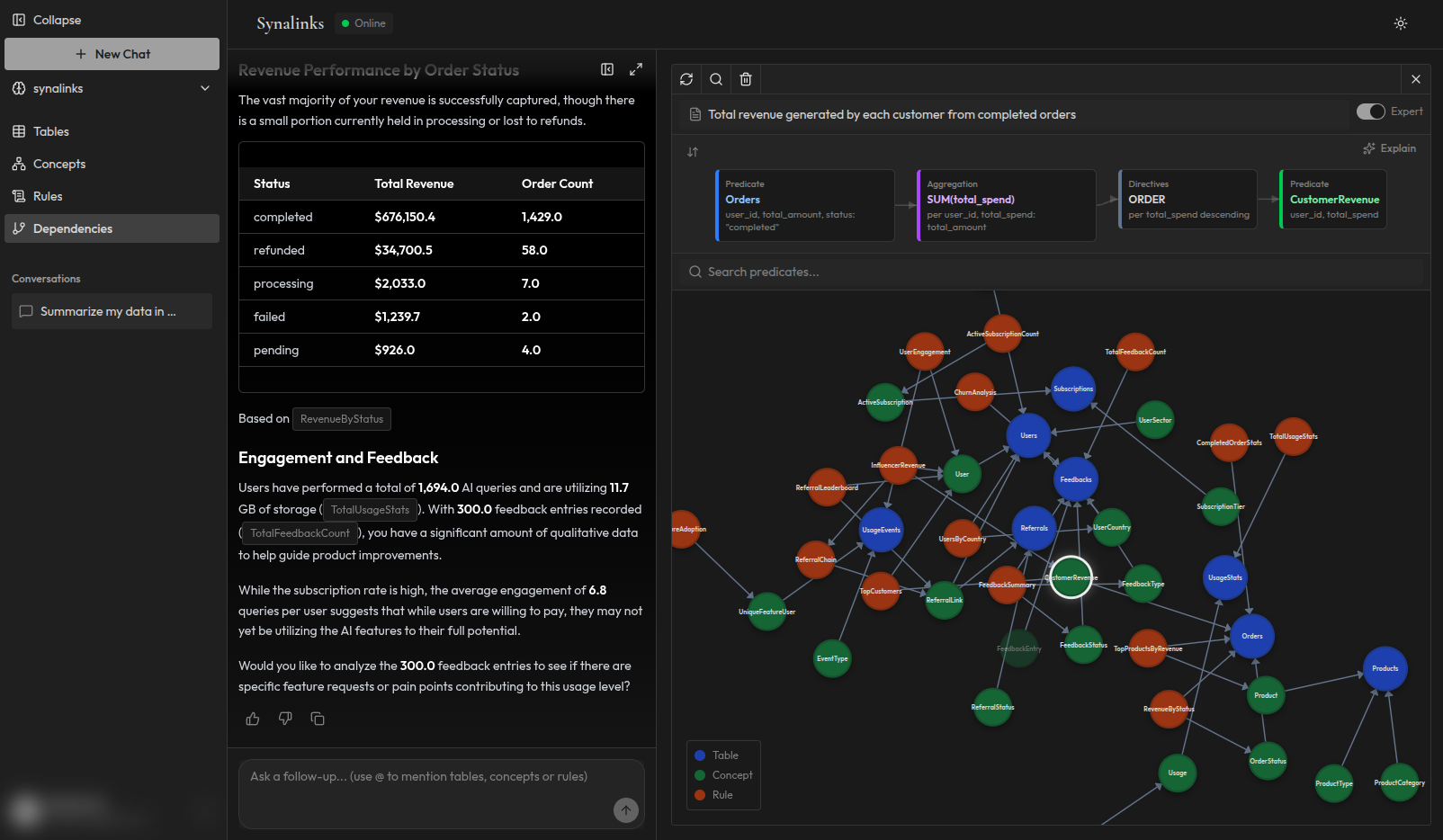
Step 3: Derive answers. When a question comes in, the system applies the rules to the structured knowledge and produces an answer through logical derivation. No token prediction. No temperature. No variation. The reasoning chain is captured at every step.
The language model's role changes from "figure out the answer" to "present the answer in natural language." It receives the derived result and formats it for the user. The heavy lifting, the actual reasoning, already happened deterministically.
Why this matters in practice
Consider a concrete scenario. You're running an AI agent for a SaaS company's customer success team. A team member asks: "Which Enterprise customers are at risk of churning this quarter?"
With probabilistic RAG: The system retrieves customer records, usage logs, and support tickets that seem relevant based on vector similarity. The language model reads through the retrieved chunks and tries to figure out what "at risk" means in this context. Maybe it uses a reasonable heuristic. Maybe it hallucinates one. You get a list, but you can't verify the criteria it applied.
With a deterministic reasoning layer: The system already knows the structured relationships between customers, their plans, their usage metrics, and their support history. "At risk" is a defined rule: usage dropped 40%+ over 90 days AND has open critical tickets AND renewal date is within the current quarter. The system applies this rule, returns the matching customers, and shows the exact reasoning chain for each one.
The difference isn't subtle. One approach gives you a plausible guess. The other gives you a provable answer.
Deterministic vs. probabilistic: when to use each
A deterministic reasoning layer doesn't replace language models. It complements them by handling the tasks where determinism matters.
Use deterministic reasoning when:
- The answer must be the same every time for the same data
- You need an audit trail showing how the answer was derived
- The question involves multi-step logic over structured relationships
- Compliance or regulatory requirements demand explainability
- Wrong answers have real business consequences
Use probabilistic generation when:
- You need creative or open-ended responses
- The task is summarization or natural language formatting
- There's no single "correct" answer
- The question is exploratory or conversational
The most effective production systems use both. The reasoning layer handles the logic. The language model handles the communication.
How Synalinks Memory implements this
Synalinks Memory is a deterministic reasoning layer built for AI agents. It works in three steps:
- Connect your data sources. Databases, spreadsheets, files, APIs. Synalinks automatically extracts and structures knowledge into verified concepts, relationships, and rules.
- Describe your domain. Tell the system what matters: your business rules, your definitions, your domain-specific logic. These become the reasoning rules.
- Query deterministically. Your agents call the Synalinks Memory API. Every query returns a derived answer with a complete reasoning chain. Same question, same data, same answer.
No embeddings. No vector search. No hoping the language model interprets the retrieved context correctly.
Getting started
If you're building AI agents that need to be reliable, traceable, and consistent, a deterministic reasoning layer is the architectural piece you're missing.
Synalinks Memory is available starting at €49/month. Connect a data source, define some rules, and see deterministic reasoning in action.
Screenshots are provided for illustration purposes. The final product may differ in some aspects. All data shown is synthetic and used for demonstration purposes only.